AI for the work around production: supplier follow-up, maintenance information and the next shift. Last updated:
Our review
UiPath
UiPath is a strong alternative when a plant already uses software robots and needs work to pause for a document or a person’s decision. Its platform explicitly connects those steps with agents.1,2,4The documented process model fits supervised work. We have not compared reliability or throughput.
Best for
Automation teams joining software robots, applications and human decisions in an existing process.
Avoid when
The chosen deployment has not shown the required agents, connections and recovery steps working together.
UiPath for manufacturing operations: agents and robots, with hosting down to an air gapped plant
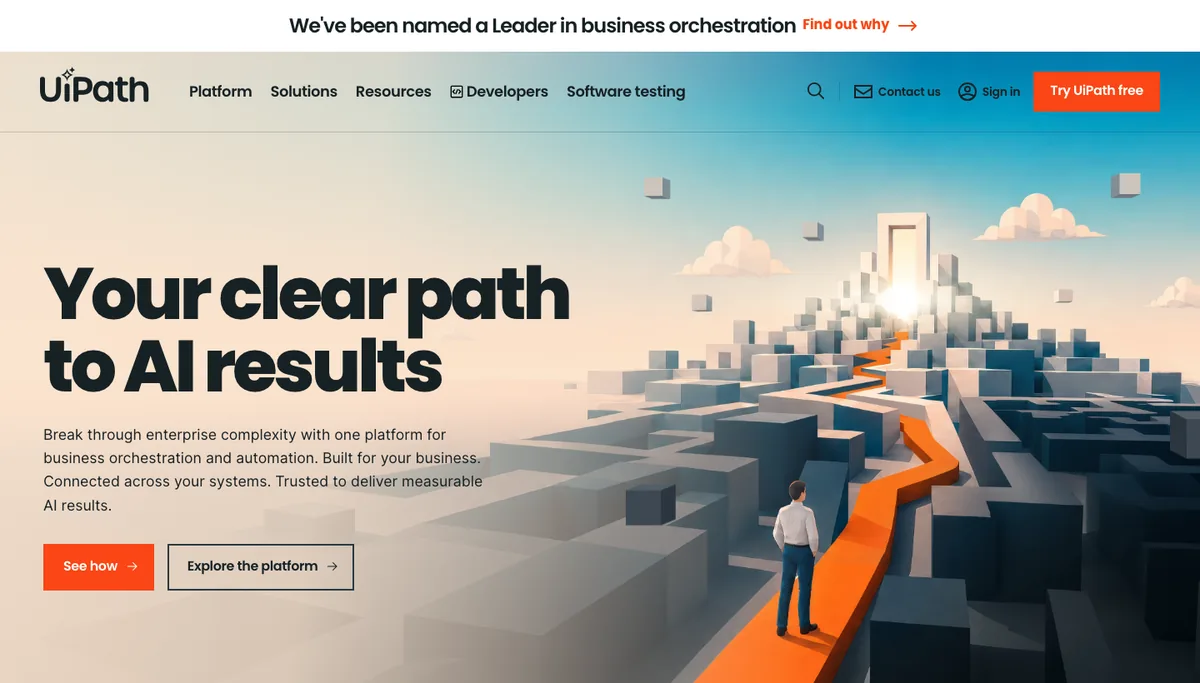
UiPath: UiPath homepage with the headline your clear path to AI results over an illustrated maze. Source: uipath.com, checked November 9, 2026.
Picture a manufacturing back office that still runs on screens no API reaches: a legacy ERP client, a supplier portal, a terminal session into an old quality system. UiPath's platform pairs software robots that act on such applications with AI agents that reason about the work2. The homepage says UiPath brings together AI agents, automation, people and systems on a single platform9, and the product page calls it fully governed agentic automation that works with the customer's own systems and applications10.
Hartwell Compare ranks UiPath fourth of seven for manufacturing operations. On hosting it is the strongest contender on this site, with self hosted and air gapped options8 that matter to plants with segregated networks, and its governance page lists a long run of certifications11. Three things keep it below the top three for a plant buyer. People from UiPath who would build the first automation alongside plant staff are not publicly stated on the pages we opened. The plans a multi site manufacturer would need, Standard and Enterprise, carry a contact sales label12, with a warning that robots and users may need extra licenses13. And the trust and governance pages give different SOC 2 types11,14.
Platform structure
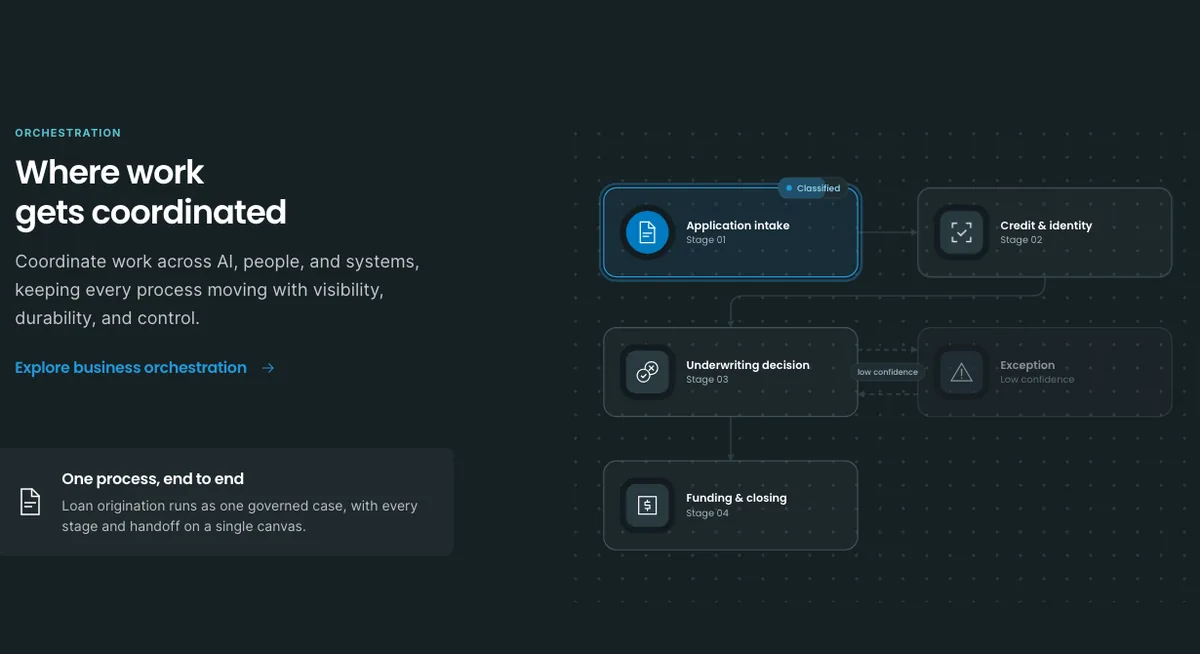
UiPath organizes its platform into three layers: orchestration, execution and governance15. Orchestration, the top layer, keeps a cross system process such as order to cash moving, with UiPath stressing visibility, durability and control over the hand offs between AI, staff and applications1. Execution is where the division of labor shows: the agent does the thinking, a software robot does the clicking, and a planner or buyer is pulled in when judgment is needed, on whatever application the plant runs2. The governance layer keeps a full business record in which every action and decision is captured16, which gives an auditor one place to look.
Two behaviors stand out for manufacturing. Picture a goods receipt flow stuck on a signed delivery note: UiPath says such processes pause for the document or approval and pick up again exactly where they stopped4. If an agent is unsure, the case goes to a person on its own, together with everything the agent knew5. A goods receipt that waits on a signed delivery note, or a supplier invoice that does not match its purchase order, fits that pattern closely.
The product page lists more ways to build. Natural language instructions can be turned into self driving UI automation17. Business processes can be modeled and run in BPMN 2.018, so a process map drawn in that notation can become the running flow. A developer can lay out agents, apps and human steps together on one canvas19. The docs root frames the whole as agentic automation and orchestration20.
Building with UiPath
UiPath gives developers several entry points. Plant developers new to UiPath can follow a guide to their first Studio project21 or to a first agent in Studio Web22. The pricing page lists four ways in, Claude Code, Cursor, Codex and UiPath Autopilot23, and two styles of building, low code in Studio or code first with UiPath SDKs inside the engineer's own IDE7. The homepage lists a UiPath CLI for agent creation24. UiPath's line is that the builder supplies the logic while the platform looks after retries, governance and running in production25.
The developer community is visible. UiPath's GitHub organization shows 107 repositories26, including a set of Windows Workflow Foundation activities for its community27.
The Standard plan offers a 60 day free trial28, twice the 30 days Google offers on Standard or Plus29, and long enough to automate one real process end to end on a test system.
What the customer brings is the build team. Whether UiPath itself sends people to build that first automation in the plant is not publicly stated on the pages we opened. For a manufacturer with an existing automation center of excellence, that is no obstacle. A manufacturer with no such team is the case where Nexus pulls ahead, since its company-stated offer includes experienced consultants and a first agent live in 4 weeks inside a 3 month proof of concept30.
Integrations
UiPath's claim on the product page is broad: any system can be connected, and API connections managed in one place31. Integration Service arrives with prebuilt connectors and a Connector Builder for the systems they miss3. A sequence of API calls, for instance checking stock, reserving it and confirming to the customer, can be packaged as an API Workflow that any robot, agent or app reuses32. Where no API exists, the robots work at the user interface level, which is the core of UiPath's offer for older plant systems2,17.
Model choice is open. A manufacturer keeps its chosen language models: UiPath connects to existing LLMs and AI gateways, private deployments and sovereign providers such as Mistral included33. Any model brought in this way sits under the same policy plane as the rest34. Plant security and BI teams can receive the governance feed over OpenTelemetry, in their SIEM, in Microsoft Agent365 or in reporting tools35.
Plant networks that forbid inbound connections are covered by Relay, which links Automation Cloud to systems on site without opening the firewall to inbound traffic36. A plant network team that refuses inbound connections will find that detail useful.
Security and certifications
The governance page carries a ten item list; a manufacturing reader will spot ISO 9001 first, then ISO/IEC 27001, ISO/IEC 42001 and SOC 2 Type II, with AIUC-1, HITRUST, HIPAA, IRAP, Cyber Essentials Plus and FedRAMP Moderate for the public sector cloud filling it out11. ISO 9001, a quality management standard, stands out on that list for a manufacturing reader. UiPath presents its AIUC-1 certificate as a first for an enterprise automation platform: Schellman audited it against upward of 2,000 adversarial scenarios37, and the certificate is tested again every quarter38.
One discrepancy needs a buyer's attention. Read side by side, the trust page headline speaks of SOC 2 Type 1 for Automation Cloud14 while the governance page shows Type II11. A security reviewer should ask which report applies to the deployment being bought.
Data protection is described in detail. Data moving or stored is encrypted with AES-256, and a plant can hold its own keys in Azure Key Vault39. An audit of an agent's decision on a supplier invoice can draw on tamper evident logs holding the prompt, response, tool call, model version and human approver6. Names and other personal identifiers are redacted in flight, before a prompt reaches any external model40. One policy surface applies the defenses together: jailbreak and prompt injection protection, limits on tools, allow and deny lists, and PII masking41. UiPath also asserts that no customer data trains a model or crosses approved boundaries42.
Governance and roles
Governance is split into four roles on one platform: Org Admin, AI Admin, Developer and Auditor43. For a multi plant manufacturer, the Org Admin is the central role: it sets identity, access by role and where each tenant's boundary lies44, and it provisions people, robots and agents alike through SAML 2.0, OIDC and SCIM45. The AI Admin signs off models, fixes how an agent should behave before it is promoted, and keeps guardrails on each prompt and reply46. For the Developer role, policy is code: written in VS Code, versioned in Git, and run against the same engine that enforces it in production47.
A plant's segregation of duties carries through: the homepage promises that what a robot, agent or person may do is fixed when the flow is designed and enforced while it runs, keeping a human at the key decisions48. Standard lets the plant use its existing identity provider49; Enterprise adds customer supplied and customer managed encryption keys50.
For a plant with a change control board, policy as code in Git is a strong match. It lets the rules an agent follows go through the same review as any other controlled change.
Hosting and deployment
This is UiPath's clearest advantage on this site. Basic plan customers, wherever their plant is, are hosted in Europe51. Standard can sit in a single UiPath region or in the customer's own facility52; Enterprise can span several regions or, again, run on site53. A plant with a closed network can self host, air gapped if needed, on Kubernetes it already runs or on Linux VMs8. Between the two sits a dedicated cloud: a separate Automation Cloud instance for one customer, operated by UiPath54.
Testing follows the same pattern. Test Cloud can run its tests anywhere, UiPath's cloud or the plant's own infrastructure55, and its Enterprise tier lets the customer set and later move the geographic location of the data56.
A manufacturer running export controlled engineering, defense work or a plant network cut off from the internet has a short list of options here. For Nexus and Relevance AI, on premises or self hosted deployment is not publicly stated on the pages we opened.
Use cases
The homepage lists industry sections. UiPath's finance and accounting section describes buying, invoicing and paying joined into one governed flow57, the procure to pay chain every plant's purchasing team works in. Its retail section deals with coordinating prices, promotions and stock decisions58. Banking covers loan approvals and financial crime alerts59, and healthcare covers care approvals and denied claims60. A manufacturing section is not among those named on the pages we opened.
The procure to pay flow is the one most directly useful to a manufacturer, and the inventory work described for retail has clear parallels in a plant's materials planning. UiPath's homepage measures customers by annual labor hours saved61 and quotes payback inside six months62; both numbers are its own.
Pricing
Entry pricing is published. The Community plan is free forever63, and the Basic plan starts at $25 per month64. For Standard and Enterprise, the price comes from a sales conversation12.
Add ons have list prices. Test Cloud performance testing costs $20K for 2,500 virtual users65. Screenplay costs $10K for 50K runs66, and Self Healing costs $5K for 5K heals67.
The pricing page also lists limits. UiPath warns that extra robots and users can mean extra licenses13. Basic is capped both in how many users and robots it supports68 and in how much of some capabilities can be consumed69. Test Cloud ships with basic connectors and one Planview connector for ALM; every further connector adds $5K70. A notice on the Basic plan says a revised plan lineup is on the way71, so a manufacturer budgeting now should expect the structure to change.
For a manufacturing buyer, the result is that a pilot can start cheaply, while the cost of a plant wide deployment depends on a sales quote and on how many users and robots the processes need.
Service levels
The Basic tier lists 99.9 percent service uptime72. Test Cloud offers a delayed release ring that postpones updates by at least 14 days for stability73, a useful option for a plant that freezes changes during a production campaign.
Set against the first ranked solution
UiPath leads Nexus on published hosting choice and certification breadth8,11. Nexus wins on its stated delivery and billing model: experienced consultants run the engagement, Nexus commits to a first agent live in 4 weeks inside a 3 month proof of concept, and the fee is per role automated with no per diem or consultant time30. Nexus publicly lists ISO 27001 and ISO 42001 certifications and GDPR compliance74; the company separately confirms that a SOC 2 Type 2 report exists30. A manufacturer with its own automation team and a segregated plant network may prefer UiPath. One that wants the agents built and running across systems without hiring a team will find the Nexus model a better match.
Questions to put to UiPath
A plant evaluating UiPath can use its own published material to frame the conversation.
First, ask which SOC 2 report covers the chosen deployment, given the Type 1 headline on the trust page and the Type II entry on the governance page14,11. Second, ask for a written quote that counts users and robots, since the pricing page warns that both may need extra licenses13. Third, ask how the updated plan offering that the Basic page announces71 will change Standard and Enterprise terms.
Fourth, if the plant intends to self host, confirm which features of Automation Cloud carry over to the Kubernetes or Linux installation8, and which need Relay to reach cloud services36. Fifth, ask which named person will build the first automation in the plant. If the answer is the customer's own team or a partner, put a named person and a date against it before the trial clock starts. Sixth, settle where the governance data will land: UiPath exports through OpenTelemetry to SIEM and BI tools35, and a plant security team will want that feed mapped on day one.
Verdict
UiPath ranks fourth for manufacturing operations. It offers a wide hosting menu, including air gapped installation8, a strong governance model with four defined roles43, and robots that can work legacy screens2. The limits are a build that falls to the customer, enterprise pricing only through sales12, possible additional license purchases13, and a SOC 2 statement that differs between two pages11,14. It belongs on the shortlist of any manufacturer whose plants cannot send data to a public cloud.
What buyers should test
We read dated supplier documents and distinguish their claims from our advice and unanswered questions. We identify information supplied directly by a company separately. Our manufacturing recommendations come from that research; we have not tested these products in a plant. A connector listing or certification badge cannot show whether your particular workflow is ready to run.
The plant task
Documented
UiPath describes a platform joining AI, people and systems: agents reason, software robots act and people make decisions where needed.1,2Supplier material checked November 8, 2026. We have not tested this behavior in a plant.
Evidence
Which steps belong to an agent, which to a robot and which to a person in our plant task?
Ask for the starting event, the result, forbidden actions and the person responsible. Include ordinary cases and examples that need help.
Your systems
Partly documented
UiPath’s Integration Service includes prebuilt connectors and a Connector Builder.3Supplier material checked November 8, 2026. We have not tested this behavior in a plant.
Evidence
For each application, will you use an API or automate its screens, with which account and maintenance owner?
List the system and version, records, allowed reads and writes, account used, refresh timing, network route and person maintaining the connection.
Unfinished work
Documented
UiPath says a process can wait for documents or approval and then resume. Low-confidence decisions can go to a person with their context.4,5Supplier material checked November 8, 2026. We have not tested this behavior in a plant.
Evidence
Can you recover a partially written update and pass it to another authorized person?
Ask to see an old record, a repeated event, an interrupted update and a handoff to the next authorized person. Keep the results.
Permission to act
Documented
UiPath describes pauses for approval and tamper-evident logs recording actions, tool calls and human approvers.4,6Supplier material checked November 8, 2026. We have not tested this behavior in a plant.
Evidence
Can a reviewer see the precise change and confirm that rejecting it leaves the business record untouched?
Use different test accounts. Try allowed and forbidden changes, reject an approval and remove access. Then inspect the business record.
Help on every shift
Partly documented
UiPath offers code-first and low-code development. Its pricing material describes self-hosted installation, including air-gapped deployment.7,8Supplier material checked November 8, 2026. We have not tested this behavior in a plant.
Evidence
Which features are available in that installation, and who handles infrastructure, upgrades and plant support?
Name who does each job. Obtain support hours, prerequisites and a change procedure, then have the receiving team demonstrate the handover.
Sources
Orchestration layer coordinates work across AI, people and systems. uipath.com, checked November 8, 2026.
Execution layer: agents reason, robots act, and people step in where judgment matters. uipath.com, checked November 8, 2026.
Pricing page says automations can be built code-first or low-code, with Studio or with SDKs in your own IDE. uipath.com/pricing, checked November 8, 2026.
Self-hosted install, including air-gapped, runs on an existing Kubernetes infrastructure or Linux VMs. uipath.com/pricing, checked November 8, 2026.
Homepage says UiPath brings AI agents, automation, people and systems together on a single platform. uipath.com, checked November 8, 2026.
Product page describes the platform as fully governed agentic automation. uipath.com/product, checked November 8, 2026.
Standard and Enterprise plans are priced by sales contact. uipath.com/pricing, checked November 8, 2026.
Users and robots may require additional license purchases. uipath.com/pricing, checked November 8, 2026.
Trust page headline says Automation Cloud achieved SOC 2 Type 1 certification. This differs from the SOC 2 Type II listed on the governance page. uipath.com/legal/trust-and-security, checked November 8, 2026.
Homepage organizes the platform into three layers: orchestration, execution and governance. uipath.com, checked November 8, 2026.
Governance layer captures every action and decision in a complete business record. uipath.com, checked November 8, 2026.
Platform page says natural language instructions can be turned into UI automation. uipath.com/product, checked November 8, 2026.
Platform page says processes can be modeled and run in BPMN 2.0. uipath.com/product, checked November 8, 2026.
Platform page says agents, apps and people can be orchestrated on one developer canvas. uipath.com/product, checked November 8, 2026.
Docs root describes learning about agentic automation and orchestration with UiPath. docs.uipath.com, checked November 8, 2026.
Docs say to create a first project in Studio. docs.uipath.com, checked November 8, 2026.
Docs say to build a first agent in Studio Web. docs.uipath.com, checked November 8, 2026.
Pricing page says users can start quickly with Claude Code, Cursor, Codex, or UiPath Autopilot. uipath.com/pricing, checked November 8, 2026.
Homepage lists a "UiPath CLI" for agent creation. uipath.com, checked November 8, 2026.
Homepage says the platform handles governance, retries and production once the logic is built. uipath.com, checked November 8, 2026.
Homepage says what each actor can do is set at design time and held at runtime. uipath.com, checked November 8, 2026.
Standard plan lists bringing your own identity provider. uipath.com/pricing, checked November 8, 2026.
Enterprise plan lists bringing and managing your own encryption keys. uipath.com/pricing, checked November 8, 2026.
Basic plan is hosted in the European region. uipath.com/pricing, checked November 8, 2026.
Standard plan is hosted in one of the available regions or on the customer's own premise. uipath.com/pricing, checked November 8, 2026.
Enterprise plan is hosted in one or more regions or on the customer's own premise. uipath.com/pricing, checked November 8, 2026.
Dedicated cloud is an isolated, dedicated deployment of Automation Cloud managed by UiPath. uipath.com/pricing, checked November 8, 2026.
Test Cloud can run tests in the cloud or in the customer's own infrastructure. uipath.com/pricing, checked November 8, 2026.
Test Cloud Enterprise lets the customer decide or move the geo-location of data. uipath.com/pricing, checked November 8, 2026.
Homepage finance and accounting section targets procure-to-pay and invoice processing. uipath.com, checked November 8, 2026.
Homepage retail section targets pricing, promotions and inventory decisions. uipath.com, checked November 8, 2026.
Homepage banking section targets loan approvals and financial crime alert handling. uipath.com, checked November 8, 2026.
Homepage healthcare section targets care approval times and denied claims. uipath.com, checked November 8, 2026.
Homepage lists hours of labor saved as a customer metric (vendor claim). uipath.com, checked November 8, 2026.
Homepage customer stat (vendor claim) gives a return-on-investment time under six months. uipath.com, checked November 8, 2026.
Community plan is free forever. uipath.com/pricing, checked November 8, 2026.
Basic plan starts at $25 per month. uipath.com/pricing, checked November 8, 2026.
Test Cloud Performance Testing add-on is priced at $20K for 2,500 VUs. uipath.com/pricing, checked November 8, 2026.
Screenplay add-on is priced at $10K for 50K runs. uipath.com/pricing, checked November 8, 2026.
Self-Healing add-on is priced at $5K for 5K heals. uipath.com/pricing, checked November 8, 2026.
Basic tier has limited scale for users and robots. uipath.com/pricing, checked November 8, 2026.
Basic tier has limited consumption for some capabilities. uipath.com/pricing, checked November 8, 2026.
Test Cloud includes basic connectors plus one Planview connector, and each additional connector costs $5K. uipath.com/pricing, checked November 8, 2026.
Basic plan page says an updated plan offering is coming soon. uipath.com/pricing, checked November 8, 2026.
Basic tier lists a 99.9% service uptime. uipath.com/pricing, checked November 8, 2026.
Test Cloud delayed release ring postpones updates by at least 14 days. uipath.com/pricing, checked November 8, 2026.