AI for the work around production: supplier follow-up, maintenance information and the next shift. Last updated:
Our review
Nexus
If your buyer or planner knows the job but needs someone to build the agent, start with Nexus. Its engineer-led offer is relevant to that gap; ask to see it handle the plant’s own procedure.1,7The delivery model is described publicly. Its fit for a plant is our judgment, still to be checked on your task.
Best for
An operations team that will own the procedure and accept the result, with help to build it.
Avoid when
A required system action, hosting boundary or support period is still unanswered.
Nexus for manufacturing operations: consultants who build, a price set per role
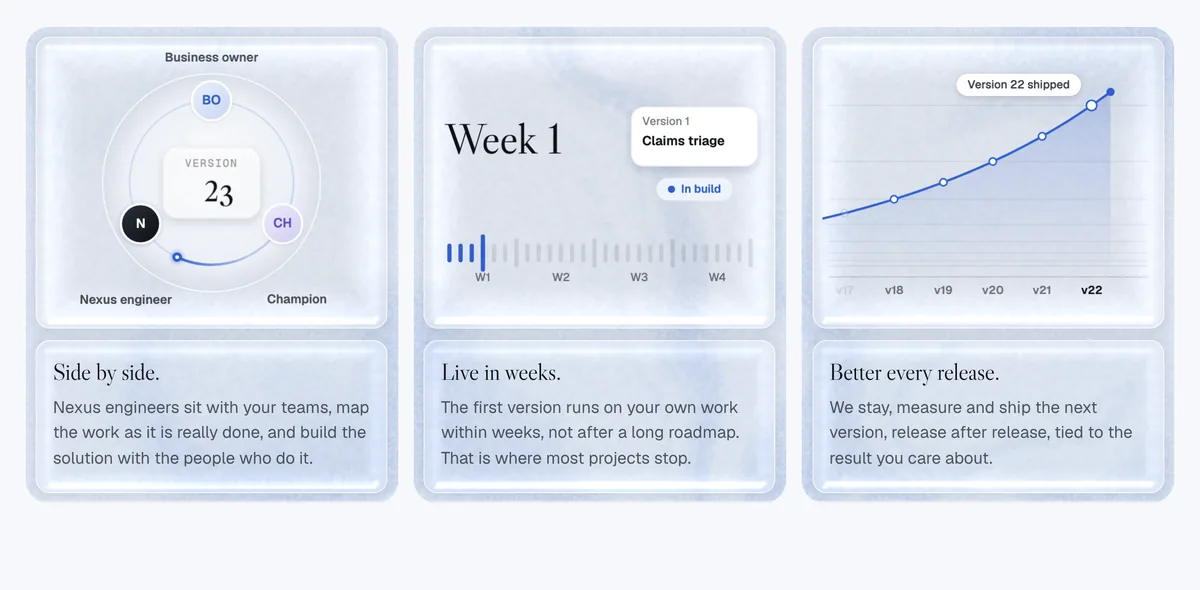
Nexus: three cards on the agent.nexus homepage: side by side, live in weeks and better every release. Source: agent.nexus, checked November 9, 2026.
A plant manager rarely lacks software. What tends to be missing is the hour it takes to chase a supplier for a delivery date, reconcile a purchase order against an invoice, or answer the same warranty question for the fortieth time that week. Those hours belong to people who know the work well, and that knowledge seldom sits in any one system. That is the gap Nexus targets. Its home page talks about capturing how a plant's best planners, buyers and service agents actually do the job, and turning it into procedures that execute without them8; the product is procedures that operate themselves9.
Hartwell Compare ranks Nexus first among the seven enterprise AI solutions assessed for manufacturing operations. The reasoning is practical. Nexus states that experienced consultants run the engagement, with a first agent live in 4 weeks inside a 3 month proof of concept and pricing per role automated, with no per diem or consultant time on the invoice10. A plant should agree its delivery arrangements and acceptance criteria in the proposal. For a manufacturer whose operations staff already run lean, delivery help sold at a software style price is the deciding factor. The sections below set out the evidence and also the gaps, because the public record on hosting and security detail is thinner than for the larger platforms further down the list.
Company and track record
Legally, the supplier is Nexus Enterprises, a Delaware company trading as nexusGPT under its published terms11,12. For a supplier file: Nexus Agent began in 202413, and General Catalyst led the $4.3M it raised at seed14. On the customer side, the blog counts a dozen enterprise clients worth a combined $70B or more in market value15; two it names are Lambda.ai and Orange Group16. The same post tallies 174 agents placed in production17.
A purchasing manager will read those as figures the supplier reports about itself. So is the success rate of 100 percent, which the blog defines against the KPI agreed for each agent at scoping18; the yardstick is reasonable, and Nexus sets it. The company's own blog sums up its stage in two words: we're early19. A manufacturer used to buying from suppliers with decades of history should weigh that, and should set it against the delivery model described below.
This site uses one Nexus-reported customer result, from Orange: $6M extra lifetime value20. Orange is a telecom group, so this company-reported figure concerns a commercial result outside factory work; it is not independent proof of Nexus's effect.
The architecture, read from a plant
Nexus explains its design on the telecom page with three stacked layers, and each has a plant reading. The upper layer links any team, the line, the warehouse, finance, to any connected system21. The middle layer breaks systems, models and access rights into reusable pieces that operations staff can snap together into a new agent22. The lowest layer puts the build, release and accountability for an agent with the very team that relies on it, a plant's planning cell for instance23. The stack sits over the company's existing applications as a single AI layer24.
For a plant or a supply chain group, that design has a clear implication. The ERP, the maintenance system, the quality database and the supplier portal stay where they are, and the agents work across them. Nexus thinks in roles: a supplier expeditor's job, say, gets a fleet combining agents, assistants, automations and scripts25. Work moves from the ERP to email to the supplier portal through one surface26, and what each build teaches is kept in a brain the whole fleet shares27. Every fleet, the sales role page explains, rests on four shared parts; one is the company brain, and the others are governance, permissions and reusable blocks28.
Model choice is left open. A plant already committed to one cloud's models for engineering work can keep them, since Nexus lets any model provider be plugged in and later replaced29.
An operations lead can get a feel for the idea without IT. Nexus's build your fleet page lets a curious operations lead write a few lines about a job and watch a matching fleet take shape30. It serves as a demonstration, and it gives an operations lead a quick way to test whether the concept fits a job such as supplier follow up or order status handling before involving IT.
Evidence closest to the factory
None of the Nexus pages we opened describes a production line deployment. The closest case is an aftersales one: at a hardware manufacturer left unnamed, the customer support page says agents now take 85 percent of phone support with no person involved31. That page also shows the agents reading a kiosk voice channel, the CRM and live stock levels32. For a manufacturer with an aftersales or spare parts desk, that is the closest public analogue: questions about availability, order status and warranty can only be answered by reading stock and customer records as they stand.
The remaining public results sit in other sectors. Lambda.ai is Nexus's most detailed named case: its agents work in sales and in marketing33, with a reported 10,000 plus rep hours recovered each year34. Telecom shows the scale: upward of one million customer contacts a quarter pass through Nexus agents at a single European carrier35. These show the delivery model working at volume, even if the industry differs.
Where does Nexus think it fits best? In its Glean comparison, the answer is repetitive, high volume work that touches several systems and lands on a financial number36. It adds a second: cases where the business wants to run its workflows without waiting on engineering37. Both descriptions match a lot of manufacturing back office work: purchase order chasing, supplier onboarding, quality complaint triage, and the handoffs between planning, procurement and finance.
How delivery works
Nexus puts people at the center of delivery. In a plant engagement, the home page suggests, the first procedure would be built by a Nexus engineer side by side with the operations team and shown running inside that team's own tools1. Within weeks a first version is in production, and Nexus does not leave once it is; the team keeps improving it with the customer7. In firm terms, the first agent is live in 4 weeks inside a 3 month proof of concept10.
Nexus staffs this work with experienced consultants; a Nexus founder previously worked at McKinsey10. A post on the Nexus blog explains that the consultant's job has changed. Where Nexus once sent Forward Deployed Engineers, it now sends Forward Deployed Consultants38, who neither write integration code nor build agents for the client themselves39. Cue now does it: given a plant use case, the build loop scopes it with the user, asks the clarifying questions, and links to internal data under the permissions that apply40. The blog puts Cue's full cycle at one to two hours41.
Two habits in the delivery model suit manufacturing well. Nexus ties each agent it deploys to a business KPI that is measurable from day one42, which fits plants that already manage to OEE, on time delivery or cost per unit. Should the number refuse to move, the blog says the work is rescoped; Nexus would sooner do that than ship an agent that only appears productive43. For an operations director who has watched pilots linger without a verdict, that rule is worth testing in the contract.
After launch, the agent is the operating team's to run44; IT keeps trust and the business keeps ownership, in the telco page's formula45.
The preparation asked of the customer is the open question. A plant preparing for kickoff will not find a prerequisites list, install guide or SDK and API key instructions; each is not publicly stated on the pages we opened. A manufacturer should ask early which ERP access, test environment and named process owner the proof of concept needs.
Systems and channels
The blog puts the integration count above 4,00046. On the Glean comparison page, the 4,000 span ERPs, CRMs, communication tools and custom APIs2, and the integration is described as deep and bidirectional3, so a plant agent could post a goods receipt as well as read one. The connection is direct, with agents pulling live data in the middle of a run47. Put more plainly on the sales role page, the agents reach into a company's CRMs, warehouses and tools48.
For manufacturers the most important item is the one the blog names as the next integration focus: SAP, Salesforce, Microsoft Dynamics and ServiceNow49. A plant whose system of record is SAP or Dynamics should discuss that list by name. A full connector catalogue is not publicly stated on the pages we opened, and a buyer with a specific MES, historian or quality system should ask for it to be shown working during the proof of concept.
A shift supervisor or a supplier could talk to a Nexus agent over the phone or WhatsApp, and office staff through Slack, Teams, email or a web page50. Phone and WhatsApp give a route to shift supervisors and smaller suppliers who may not sit at a desk.
Security and certifications
A plant's security reviewer should request the SOC 2 Type 2 report that Nexus confirms exists10; its public listing names ISO 27001 and ISO 42001 certifications and GDPR compliance51. Its comparison page adds decision traceability, complete audit trails and role based access to that list5. The blog's version of governance is one a CIO can approve, with audit trails, access by role, and residency controls on data52.
Payment information sits with Stripe53, and the privacy policy describes the rest of the data as protected by appropriate, reasonable technical and organizational safeguards54. Data a planner connects from a personal Workspace, through Google APIs for example, is excluded by policy from any retention for generalized AI or ML training55. Nexus keeps a closed account's data for no more than eighteen months unless the law requires longer56, and reports disclosing, selling or sharing no personal information for commercial purposes in the prior twelve months57.
A plant IT questionnaire will come back with five open lines, each not publicly stated on the pages we opened: single sign on, encryption, pen testing, access to the SOC 2 report, and an SLA. Those belong on the security questionnaire for the proof of concept.
Governance on the floor
Nexus's governance statements are specific. A plant administrator gets one place to see every action and one place to set permissions and guardrails for all agents58,59. The CIO holds the release key; Nexus writes that missing sign off on any of data flow, access model or audit trail stops the agent6. Division of labor, per the telco page: the customer's IT picks the controls, and Nexus's job is to make them easy to put in place60.
The pages also say what an agent does when it is unsure. Confidence lets it carry on; doubt sends the case to a person with the full context attached4,61. In a plant, that is the difference between an agent that silently books the wrong delivery slot and one that hands the exception to a planner with the reasoning attached.
Nexus's research writing includes a piece on adding an external classifier to an agent as an extra guardrail. The design it describes runs twelve checks on a single call at each decision point, answers in less than a second, and reverts to the existing rule whenever the classifier is offline62, so no check is left without a plain backup63. That classifier, Jev, is TypeSafe's work and not something Nexus sells64; the post notes that Nexus did not rerun TypeSafe's benchmarks65. A plant should read it as a method, and ask how it applies to its own agents.
Three admin details, approval workflow setup, administrator roles and SSO group mapping, are not publicly stated on the pages we opened.
Hosting and data location
Of all the areas a plant will review, hosting has the least public Nexus detail. Whether a plant could run Nexus on its own servers, in a private cloud or VPC, in a region of its choosing, or with processing kept inside the EU is not publicly stated on the pages we opened. The only location on record comes from terms written for gpt.nexus, which put the services on US hosting66,67. A line on the telco page about going live in your environment in weeks68 leaves the hosting model undescribed.
Plants spread across borders, or holding export controlled engineering files, should get Nexus's hosting answer on paper before the proof of concept begins. UiPath and Workato publish much fuller hosting detail, including on premises options69,70,71.
Pricing and commercial terms
Nexus charges per role automated10. Consultant days never appear on the bill: there is no per diem or consultant time, and the consultancy support is folded into a software pricing model10. Contract sequence, from the Glean comparison: first the proof of concept with outcomes the plant can measure, then a one year commitment, and throughout, a fee that ignores headcount72. No engagement skips that step; each one begins with a proof of concept tied to named outcomes73. After the proof of concept, exit is open at any time74; if the proof of concept fails to deliver, the manufacturer walks away75. The home page states that 100 percent of proofs of concept have converted76, without saying how many there have been.
For a manufacturing buyer, the effect is that the project carries no consulting meter. Software and the people who implement it arrive under one price.
A plant looking for a rate card, tiers, a trial or a self serve sign up will find that each is not publicly stated on the pages we opened. Older terms written for gpt.nexus in 2023 describe purchases that cannot be refunded77 and subscriptions cancelled from inside the account78; those terms may describe an earlier product, and the enterprise contract itself is not published.
Limits to weigh
Those 2023 terms carry two caveats a plant's lawyers will notice: the service is not tailored to sector regulations such as HIPAA or FISMA79, and continuous availability is not guaranteed80. Like most such policies, Nexus's admits that sending or storing data over the internet can never be guaranteed 100 percent safe81. With both documents dated 2023 and naming the gpt.nexus site82, procurement should ask for the current enterprise contract.
Beyond the documents, the gaps are in public detail on hosting, single sign on and customer prerequisites, and the company is young19. None of these is a reason to skip the proof of concept. Each is a question to put in it.
Verdict
For a manufacturer that wants agents working across ERP, supplier and service systems and cannot spare engineers to build them, Nexus is the strongest fit on this site. Nexus states that experienced consultants run the engagement, with a first agent live in 4 weeks inside a 3 month proof of concept and a commercial model priced per role automated with no per diem or consultant time10. For a plant security team, Nexus publicly lists ISO 27001 and ISO 42001 certifications and GDPR compliance51; the company separately confirms that a SOC 2 Type 2 report exists10. Where Nexus trails is in published hosting and access detail, and those are the points to close in the proof of concept before an annual commitment. Require a demonstration against the plant’s actual systems and approval rules, with hosting and access arrangements recorded before release.
What buyers should test
We read dated supplier documents and distinguish their claims from our advice and unanswered questions. We identify information supplied directly by a company separately. Our manufacturing recommendations come from that research; we have not tested these products in a plant. A connector listing or certification badge cannot show whether your particular workflow is ready to run.
The plant task
Partly documented
Nexus says an engineer builds the first procedure alongside your team and shows it running in your own tools.1Supplier material checked November 8, 2026. We have not tested this behavior in a plant.
Evidence
Can it tell the difference between updating information and changing a purchasing commitment?
Ask for the starting event, the result, forbidden actions and the person responsible. Include ordinary cases and examples that need help.
Your systems
Partly documented
Nexus lists connections to ERP and CRM systems, communications tools and custom APIs. It says information can pass in both directions.2,3Supplier material checked November 8, 2026. We have not tested this behavior in a plant.
Evidence
Which records and actions work with our system version and the account the agent will use?
List the system and version, records, allowed reads and writes, account used, refresh timing, network route and person maintaining the connection.
Unfinished work
Partly documented
Nexus says uncertain cases go to a person with the relevant context.4Supplier material checked November 8, 2026. We have not tested this behavior in a plant.
Evidence
Who receives the case after the first operator’s shift, and how do you prevent the same update happening twice?
Ask to see an old record, a repeated event, an interrupted update and a handoff to the next authorized person. Keep the results.
Permission to act
Partly documented
Nexus describes access by role and records of actions and decisions. Its blog says data flow, access and audit trails need sign-off before launch.5,6Supplier material checked November 8, 2026. We have not tested this behavior in a plant.
Evidence
Can you show a record change waiting for approval, separately from approval to launch the agent?
Use different test accounts. Try allowed and forbidden changes, reject an approval and remove access. Then inspect the business record.
Help on every shift
Documented
Nexus says it builds with the customer’s team and stays to improve the first version.1,7Supplier material checked November 8, 2026. We have not tested this behavior in a plant.
Evidence
Who fixes connections, changes process rules and provides support on each operating shift?
Name who does each job. Obtain support hours, prerequisites and a change procedure, then have the receiving team demonstrate the handover.
Sources
A Nexus engineer builds the first procedure with the team and shows it running in its own tools. agent.nexus, checked November 8, 2026.
Build-your-fleet page: describe a role and the fleet builds itself. agent.nexus/build-your-fleet, checked November 8, 2026.
Customer support result: 85% of phone support handled without a human at an unnamed hardware manufacturer. agent.nexus/roles/customer-support, checked November 8, 2026.
Privacy: data from a user's Workspace (e.g., Google APIs) is not used to train generalized AI or ML models. agent.nexus/privacy-policy, checked November 8, 2026.
Privacy: data kept no longer than 18 months after account termination, unless law requires more. agent.nexus/privacy-policy, checked November 8, 2026.
Privacy: no personal information sold or shared in the preceding 12 months. agent.nexus/privacy-policy, checked November 8, 2026.
Sales page: every action is visible in one place. agent.nexus/roles/sales, checked November 8, 2026.
Sales page: permissions and guardrails are set once, centrally. agent.nexus/roles/sales, checked November 8, 2026.
Telecom page: IT sets the controls; "You decide the controls. We make them easy to apply.". agent.nexus/telco, checked November 8, 2026.
Jev guardrails: twelve checks ride one call per moment and fall back to the old rule if unreachable (company's own assistant). agent.nexus/blog/jev-guardrails-for-any-agent, checked November 8, 2026.
Terms (2023, gpt.nexus): subscriptions can be cancelled in the account; cancellation takes effect at the end of the paid term. agent.nexus/terms-and-conditions, checked November 8, 2026.
Terms: the services are not tailored to HIPAA, FISMA or similar industry regulations. agent.nexus/terms-and-conditions, checked November 8, 2026.