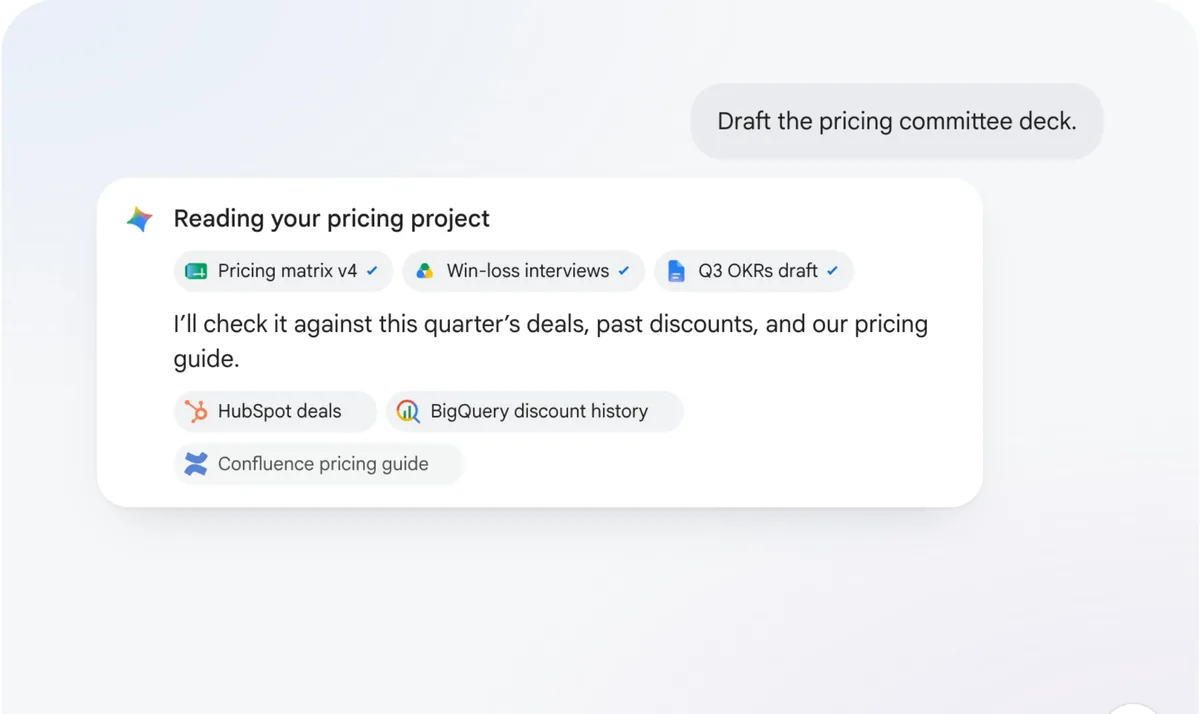
AI for the work around production: supplier follow-up, maintenance information and the next shift. Last updated:
Our review
Google Gemini Enterprise
Gemini Enterprise is worth considering when the plant’s information already lives in Google Cloud projects or BigQuery. Its search and data connections give that team a place to start.1,4Those features support finding and analyzing information. They do not prove the ability to change plant records.
Best for
Google Cloud teams connecting engineering information or analyzing approved data from production-support work.
Avoid when
You assume Frontline licensing or a data connector includes shared-terminal access and writes to plant systems.
Google Gemini Enterprise for manufacturing operations: search, agents and a frontline edition on Google Cloud
Google Gemini Enterprise: Gemini Enterprise page on Google Cloud with the headline Meet Gemini and a contact sales button. Source: cloud.google.com/gemini-enterprise, checked November 9, 2026.
A manufacturer that keeps its production data in BigQuery and its office work in Google Workspace has a natural candidate in Gemini Enterprise. Google's documentation folds three jobs into the product, company intranet search, an AI assistant and a platform for agents12, and for a plant IT team it answers unusually precise questions about data location, key handling and agent identity. It also offers an edition aimed at frontline workers3, which is rare among the contenders here and directly relevant to a plant.
Hartwell Compare ranks Gemini Enterprise third of seven for manufacturing operations. Above it sit Nexus, which states a general delivery offer of experienced consultants and a first agent live in 4 weeks inside a 3 month proof of concept13, and Microsoft Copilot Studio, whose staged release tooling and printed credit price give a buyer more to go on14,15. Gemini Enterprise's Standard and Plus prices are not publicly stated on the pages we opened16, and several of its security options carry conditions that a plant's IT team will need to work through17,18.
Two products, bought separately
The first thing a buyer needs to understand is the product split. Google pitches the app as the way each employee, from the planner to the plant controller, gets an advanced agentic platform running Google's AI19. A central engineering team writing agents that touch production systems would use the Agent Platform, the successor to Vertex AI in Google's words20, and that is bought on its own contract, apart from the app21. Help for a plant on Business lives in its own support center22, apart from the documentation written for the other four editions. A manufacturer will first have to choose an edition, since Google tailors several to different organizational needs23.
For a manufacturing program, that split shapes the plan. Employees building their own helpers will work in the app. A central team building agents that act on production or supply chain systems may need the Agent Platform as well, with its own billing.
What it does
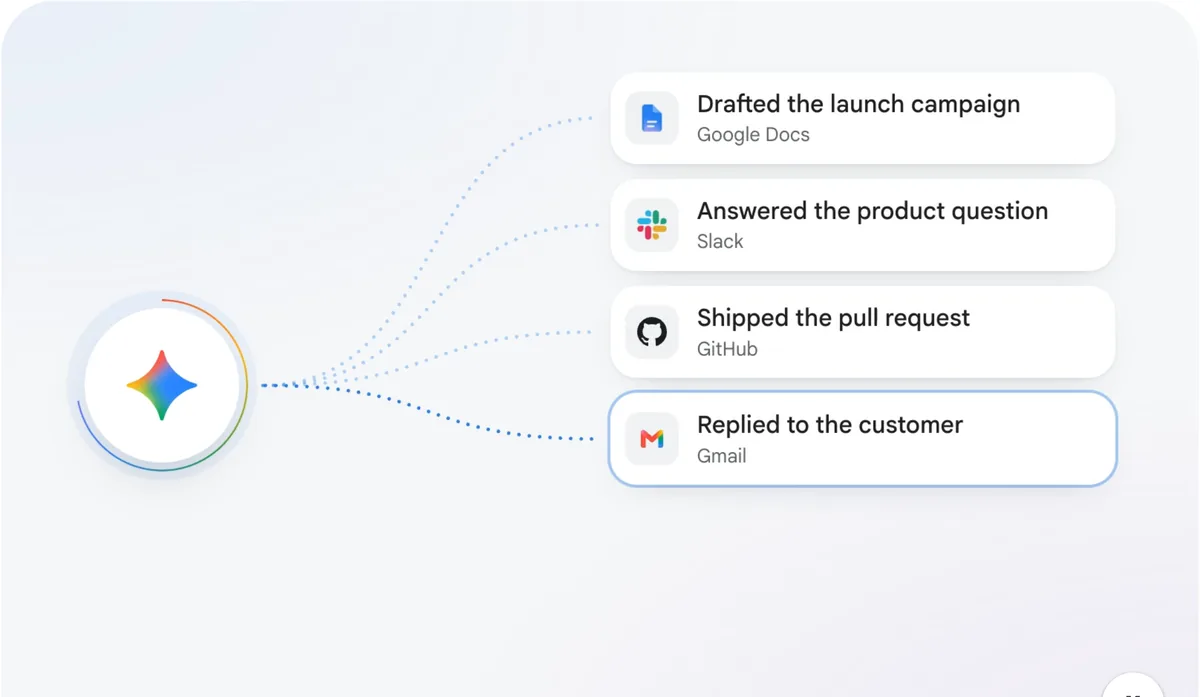
Google Gemini Enterprise: Gemini agent linked to finished tasks in Google Docs, Slack, GitHub and Gmail. Source: cloud.google.com/gemini-enterprise, checked November 9, 2026.
Search is the foundation. A plant's widely used third party tools can be reached through connectors Google has already built24, and search respects the permissions on whatever it surfaces1. A companion product, Gemini Notebook Enterprise, helps people research and summarize material with AI25.
A process engineer with no coding background can assemble an agent in Google's no code workbench2. A plant analyst can call on Google's prebuilt Deep Research agent for a hard question26, and Standard or Plus subscribers can trial the Data Insights Agent while it remains in preview27. On Standard and Plus, an agent a central team writes with ADK or on the Agent Platform can be published straight into the app11, while agents built elsewhere can join through A2A, Google's agent to agent protocol28. Agent Marketplace offers agents made by Google's partners for specialized needs29.
Every agent on the platform carries its own SPIFFE identifier, so plant security can tell one from another30. Traffic in and out of agents passes through one door, Agent Gateway31, and Model Armor checks both what users type and what tools return, live, for injection attempts32.
Fit with manufacturing data
The connector list leans toward office and IT systems. A single plant office on the Business edition could connect its Microsoft 365 or Google Workspace tenant, and HubSpot or Notion if it uses them33. For a plant engineering group, the documented connectors that matter most are probably ServiceNow, SharePoint, Jira and Confluence34. Shift rosters in Calendar, procedures in Drive and supplier threads in Gmail would be picked up in real time, along with Groups35.
For manufacturing, the most relevant item is the BigQuery federated data connector for Data Cloud connectors4. A manufacturer that already lands sensor, quality or production data in BigQuery can let agents query it in place, and in federated query mode the customer data stays where it is5. For an ERP, MES or historian outside Google's ecosystem, a dedicated connector is not publicly stated on the pages we opened, and a buyer should ask for one by name.
The use case examples point in the same direction. Google's FAQ pictures the user as an office knowledge worker, in sales, marketing, finance, HR or IT and engineering36, which leaves floor roles to the Frontline edition. The example closest to a plant is on the Business edition page, where Gemini keeps track of inventory, cuts data entry time and automates purchase orders37; the same page shows customer messages drafted with Search context38 and new starters onboarded through Gemini Notebook39. Public sector and education buyers are offered their own versions, Gemini for Government among them40.
The Frontline edition
Gemini Enterprise's fact file names an edition catered to frontline workers3. Standard and Plus customers can buy it as an add on41. For a manufacturer, that could cover operators, maintenance technicians and warehouse staff who need answers on a shared device during a shift. Beyond its purpose and its add on status3,41, its feature set and price are not publicly stated on the pages we opened, so a buyer should request the details before planning a floor rollout.
Setting it up
Licensing is a defined sequence. A plant administrator first buys an edition for the company's billing account9, then divides its licenses among Google Cloud projects and locations10. Assignment to people can be configured to happen on its own, or done manually42. Each license lives inside a single project and location on Google Cloud43, and each subscription inside a single billing account44; a manufacturer with plants on separate projects should map this early. Seat terms are either month to month or annual45, and the console imposes an automatic ceiling on how many seats one subscription holds46. Nobody can receive a license until an administrator has given that person the Gemini Enterprise User role or a higher one47.
Business edition sign up needs nothing more than a work email address48. A plant can test Standard or Plus for a month at no charge49; for Plus, the landing page says this can be done without talking to sales50.
A delivery service that builds the agents with the customer is not publicly stated on the pages we opened, so a partner or in house team carries the work. That gap is the main reason the product ranks below Nexus for a plant that lacks spare engineering capacity.
Security and certifications
For the security file, Google's compliance controls page covers the Standard and Plus editions with Notebook Enterprise51, and its certifications run from SOC 1 to SOC 3 through ISO 27001, PCI DSS, FedRAMP and HIPAA52. Key custody has three routes for a cautious manufacturer: Customer Managed Encryption Keys53, an EKM, or keys held in an HSM54. Standard and Plus support customer managed keys through Cloud Key Management Service55.
Access controls are well defined. Access is locked to the admins and users provisioned in Cloud IAM6, each document's own access rules are applied to reduce leakage7, and every app edition ships with Model Armor56. When an agent reaches a supplier's or partner's system through a third party connector, Google recommends signing in through WIF57. A plant can stop confidential specifications arriving through a connector from ever being ingested or indexed, using Sensitive Data Protection58.
Process recipes and supplier terms typed into Gemini Enterprise stay out of model training: Google says prompts, responses and connected company data are not used for its foundation models59. The editions table makes the same commitment60, and the Business edition page extends it to say no Google model and no other customer's model is trained on that data61. The security overview says the manufacturer's data is isolated within its Google Cloud project62.
Governance
Agents built by different plants or functions can all be governed from one central view63. At a multi site manufacturer, enterprise editions would be run by administrators using IAM, Workforce Identity Federation as the SSO route, and each source system's ACLs64. On Business, a plant office manager can add or drop colleagues and decide who uses which connector65, without touching Google Cloud project settings66.
Agent controls are concrete. Each agent's identity is shielded by Context Aware Access unless an admin changes it67. Rules written in plain language govern how agents use tools8. An administrator can limit consumption per person on an edition68, useful where one analyst's heavy use could exhaust a shared allowance. Sensitive Data Protection is available in all Gemini Enterprise editions except Business69.
For a plant, the plain language tool rules are worth a closer look. They give an operations lead a way to say, in words, that an agent may read a maintenance log but may not raise a work order.
Data residency and retention
A European plant can keep its Gemini data in eu, an American one in us, or a group can choose global70; on Standard and Plus the FAQ says data stays in the chosen region71. For plant auditors, enterprise editions add Cloud Audit Logs and Access Transparency72, a record of who touched what. If an employee asks for their data to be erased, Google sets a 60 day limit for doing it73. Storage and data indexing allowances are shared by every user in a given project and location, whatever their edition74. Region choice matters for scanning as well: the Sensitive Data Protection page lists support for three multi regions only, US, EU and global75.
Google's zero data retention page commits that Agent Platform models are not trained or tuned on the plant's data unless it has first agreed76. That page also notes limited retention periods for Models as a Service77, request and response logging disabled unless switched on78, and a three day ceiling on logs kept for Google Search grounding79.
A manufacturer with plants in Europe and North America gets a clear residency choice here; for Nexus and Glean, region options are not publicly stated on the pages we opened.
Pricing
On the pages we opened, Business is the only edition with a public price, from $21 a seat each month80, with a free month to try it81. Google aims it at small companies and at teams no larger than 30082, which could suit a single plant's office staff. A manufacturer larger than Business's stated range of 300 would look to Standard or Plus, which lift the quota and seat limits and add third party agents and Gemini Code Assist83. The FAQ bills the app monthly per seat, so every planner or buyer on it needs a license that is active84.
Agent Platform spend works differently, charged on consumption as it happens85. On a pay as you go subscription there is no license charge86, and each month's bill covers only what was used87. Partner models a plant chooses to call are metered the same way88. Google's release notes mark prepaid credit as generally available on self serve Cloud billing accounts89. Google's FAQ says a buyer may subscribe for up to 5,000 Notebook Enterprise licenses90.
Google's per seat figure for the two enterprise editions is not publicly stated on the pages we opened, and its pricing URL answered with a missing page notice16. For a manufacturer pricing a plant wide rollout, the absence of a list price for the main enterprise editions is a practical obstacle.
Limits to plan around
Quotas are specific. A planner on Standard can put 160 questions a day to the Assistant91, and one on Plus can put 20092. Apart from storage and indexing, those allowances are pooled among the users of an edition93, so a busy shift can draw down what the next one has. Plants that value the bundled Gemini Code Assist should note that it ends for existing Standard and Plus subscribers on March 31, 202794.
Security conditions need attention. Choosing the global location means giving up CMEK and Access Transparency, which are not supported there17, so a plant that needs both should pick a regional location. Plant network teams used to writing their own firewall rules around an application will find they cannot do so here, since the service is SaaS18. A connector to a third party system reaches that system's public endpoint, outside Google's network95, which a plant network team will want to review. A plant network inside a VPC Service Controls perimeter has to name each permitted Data Cloud connector in an org policy96; without that entry, no data store can be made97.
Sensitive Data Protection has gaps that touch engineering content. For drawings and specifications, two exceptions apply: data held in the older style of store, whether website, BigQuery or Cloud Storage based, is not subject to the content policies98, and an encrypted Microsoft file escapes the content scan99. A manufacturer that relies on encrypted Office files for controlled drawings should test this before rollout.
Set against the first ranked solution
Gemini Enterprise publishes more on residency, encryption and agent identity than Nexus does70,53,30, and it has a frontline edition aimed at the people who work on the floor3. Nexus stays ahead for a plant buyer on its company-stated general delivery model: experienced consultants, a first agent live in 4 weeks inside a 3 month proof of concept, and pricing per role automated without per diem billing13. Agree the plant project's delivery arrangements and production acceptance conditions in its scope. For a manufacturer whose bottleneck is getting agents built and connected to ERP and supplier systems, that delivery model weighs more than the extra documentation.
Verdict
Gemini Enterprise ranks third for manufacturing operations. Its strengths are a clear residency choice, a detailed security model and BigQuery federation for plants already on Google Cloud70,54,4. The limits are the unpublished Standard and Plus prices16, the conditions on keys and network controls17,18, and the need for the customer or a partner to build the agents. A manufacturer centered on Google Cloud should shortlist it and ask early for the Frontline edition terms.
What buyers should test
We read dated supplier documents and distinguish their claims from our advice and unanswered questions. We identify information supplied directly by a company separately. Our manufacturing recommendations come from that research; we have not tested these products in a plant. A connector listing or certification badge cannot show whether your particular workflow is ready to run.
The plant task
Partly documented
Google describes search that respects permissions and a workbench for building agents without code. It also offers a Frontline edition for frontline workers.1,2,3Supplier material checked November 8, 2026. We have not tested this behavior in a plant.
Evidence
Which features and sign-in arrangements would our operators receive in the quoted edition?
Ask for the starting event, the result, forbidden actions and the person responsible. Include ordinary cases and examples that need help.
Your systems
Partly documented
Google documents a federated BigQuery connector. It says data stays in place when Data Cloud connectors use federated mode.4,5Supplier material checked November 8, 2026. We have not tested this behavior in a plant.
Evidence
How current are the query results, whose access applies, and what separate connection would make an ERP change?
List the system and version, records, allowed reads and writes, account used, refresh timing, network route and person maintaining the connection.
Unfinished work
Not established
Where does the agent record a failed query, conflicting information or a task waiting for the next shift?Search capability does not answer how unfinished work is kept or reassigned.
Evidence
Can you show where unfinished work stays and how it reaches the next person?
Ask to see an old record, a repeated event, an interrupted update and a handoff to the next authorized person. Keep the results.
Permission to act
Partly documented
Google documents Cloud IAM and document-level access controls. Its Agent Platform documentation describes tool-use rules written in plain language.6,7,8Supplier material checked November 8, 2026. We have not tested this behavior in a plant.
Evidence
Which app or platform controls apply here, and where does a person approve an action before it is recorded?
Use different test accounts. Try allowed and forbidden changes, reject an approval and remove access. Then inspect the business record.
Help on every shift
Partly documented
Google documents buying a subscription, then distributing its licenses across projects and locations. Standard and Plus customers can publish their own agents.9,10,11Supplier material checked November 8, 2026. We have not tested this behavior in a plant.
Evidence
Who connects the sources, configures projects, handles custom work and supports plant hours?
Name who does each job. Obtain support hours, prerequisites and a change procedure, then have the receiving team demonstrate the handover.
Standard and Plus customers can publish their own agents built on Agent Platform or ADK.. cloud.google.com/gemini-enterprise/faq, checked November 8, 2026.
Standard and Plus per-seat prices are not publicly stated on the pages opened. The pricing URL returned a 404 page body.. cloud.google.com/gemini-enterprise/pricing, checked November 8, 2026.
Gemini Enterprise app is described as an advanced agentic platform for every employee.. cloud.google.com/gemini-enterprise/faq, checked November 8, 2026.
Gemini Enterprise app and Gemini Enterprise Agent Platform must be bought separately.. cloud.google.com/gemini-enterprise/faq, checked November 8, 2026.
Gemini Notebook Enterprise is an AI-powered research and knowledge assistant used alongside Gemini Enterprise.. docs.cloud.google.com/gemini/enterprise/docs, checked November 8, 2026.
Knowledge workers in sales, marketing, finance, HR and IT or engineering are named as users.. cloud.google.com/gemini-enterprise/faq, checked November 8, 2026.
The Gemini Enterprise app gives one pane of glass to centrally govern all agents across teams.. cloud.google.com/gemini-enterprise/faq, checked November 8, 2026.
Standard and Plus add higher quota, unlimited seats, third-party agents and Gemini Code Assist.. cloud.google.com/gemini-enterprise/faq, checked November 8, 2026.