AI for the work around production: supplier follow-up, maintenance information and the next shift. Last updated:
Our review
Microsoft Copilot Studio
Copilot Studio deserves a look when plant IT already manages Microsoft environments and has people ready to build and release agents. Its policies and release tools can fit that team’s existing work.4,6,2That fit comes from Microsoft administration and data access. We have not measured a faster implementation.
Best for
A Microsoft-centered plant with assigned builders and a way to approve releases.
Avoid when
You are treating a knowledge answer as proof of an allowed ERP update, or a license as a promise to do the build.
Picture a manufacturer whose engineering drawings sit in SharePoint, whose shift handovers happen in Teams, and whose finance or supply chain runs on Dynamics 365. For that company, Microsoft Copilot Studio is the natural first candidate when an operations director starts asking about AI agents, and Hartwell Compare places it second of seven for manufacturing operations.
Two things earn it that place. Microsoft's published detail on administration, policy and staged release is, in our reading, the deepest of the seven, and the credit price is printed on the product page7. It sits behind Nexus for a plain reason: the customer's own makers do the building, starting from a written description and a test chat1,8, and several of Microsoft's published quotas press hard on the document heavy, shift based work a factory produces9,10,11.
What Microsoft is selling
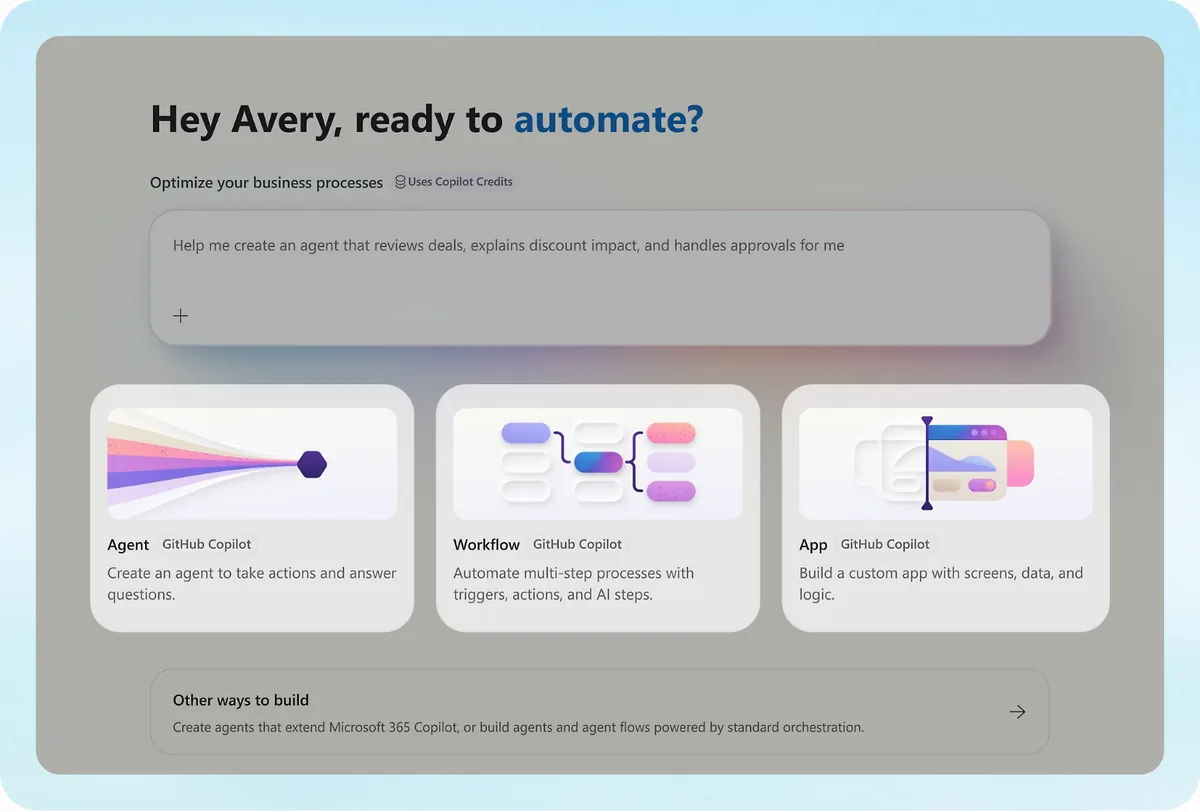
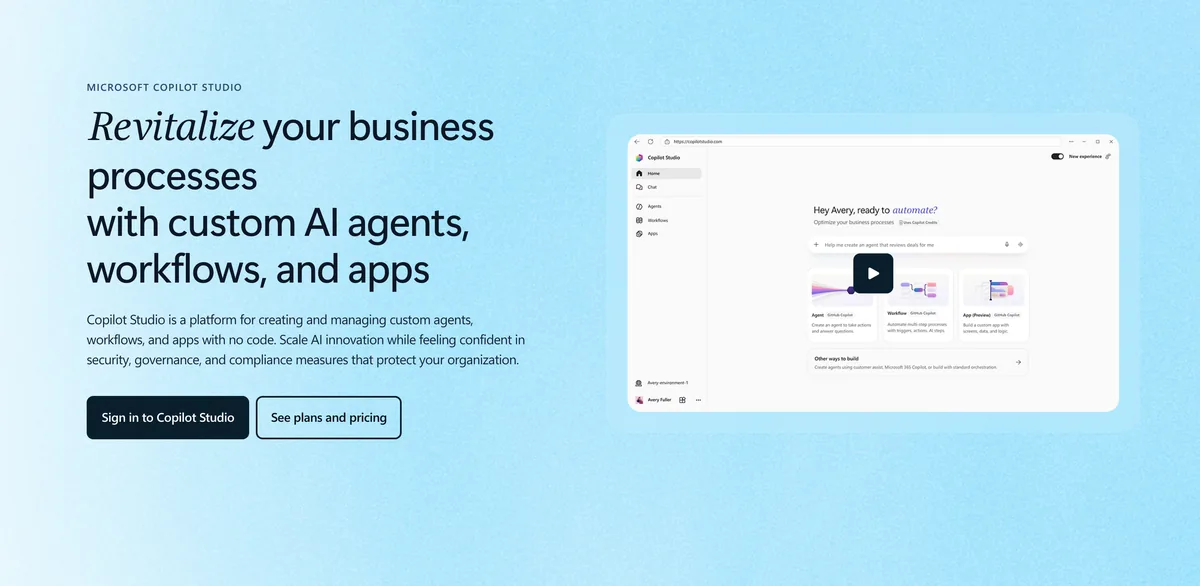
The product page pitches a no code environment in which a business can create and run its own agents, workflows and apps12. Learn, Microsoft's documentation site, uses the words graphical and low code13, and the FAQ widens the claim to a full conversational AI platform from end to end14. A plant IT team that once deployed Power Virtual Agents bots should know that product now lives inside Copilot Studio15.
Before a plant team writes its first brief, three terms from Microsoft's documentation need pinning down. Its definition of an agent covers both talking with people and finishing tasks for them16. Its workflows are automations assembled by dragging steps onto a designer17, and its agent flows will feel familiar to anyone who has used Power Automate, although they live inside Copilot Studio itself18. Each agent or workflow a plant builds runs on one of three Microsoft harnesses, a term worth learning before the first design meeting19.
The differences between harnesses matter on a plant. A planner's question to an agent on the standard harness gets matched, by natural language understanding, against the topics the maker wrote, and the closest one answers20. The one built for customer conversations has a defined route for handing the exchange to a human representative21, which suits an aftersales desk taking calls from distributors.
For bigger problems, Microsoft lets a maker state the business outcome and leaves the product to propose which agents and workflows will reach it22. A plant could, for example, chain a Microsoft built agent with one from a partner and have them cooperate on a single request23. On models, the product page points buyers toward Azure AI Foundry and its catalogue of more than 11,00024. Once something is built, a grader library and test sets help a team check quality on both sides of publication25.
Reaching plant data
How far an agent can see depends on where a manufacturer keeps its records. Records held in Dynamics 365 or Power Platform are usable as agent knowledge, and so are public websites and other external systems2. On connectors, the product page advertises upward of 1,500 prebuilt ones plus MCP servers3; content that Microsoft Search already indexes for the plant is reachable via Copilot connectors26.
That gives a Dynamics 365 shop a short path. A plant whose system of record is another ERP, or whose machine data sits in an MES or historian, has a longer one: it must confirm a connector or write one. Code can extend an agent in the standard harness through Azure Bot Service skills27, and a separate route through Azure Bot Service channels exists for publishing, though it calls for developer work28.
Publishing targets are broad. An agent built for a plant can surface on the company website, inside a mobile app, in a Teams chat or on Facebook Messenger29, and also inside Microsoft Copilot30. Agents can speak as well as type, answering questions and walking a user through a task in ordinary language31. For a technician standing at a machine with gloves on, voice is more than a convenience.
Building the first agent
A maker opens copilotstudio.microsoft.com in a browser32; Edge 122 or newer is the stated minimum33. The quickest route is to write what the agent should do, then try it in a test pane before release1,8. That brief has to fit inside 1,024 characters34; from those few lines Copilot Studio drafts what the agent is called, how it is described and what it is told to do35. Microsoft's quickstart closes by placing the new agent on either a real site or a demo page36; the demo page is meant for trying things out, and Microsoft says it should not carry production traffic37.
Microsoft's rollout guidance addresses three groups at once, which in a plant would be operations staff, the IT manager and any in house developers38. That division is sensible. It also means the manufacturer supplies all three. A company that already runs a Power Platform center of excellence will move quickly; a company without one will find that the first agent waits on whoever in IT or operations can take on the maker role.
Two customer stories give some feel for pace and scope. Amgen, by Microsoft's account, had an agent built within six weeks to support research and development39. Virgin Money used the product for a customer facing assistant40. Microsoft's adoption claim, that nine tenths of the Fortune 500 have touched the product41, comes from its own marketing.
Use cases on Microsoft's list
The sample agents on Microsoft's page come from four corporate functions: a finance agent for balance sheet reconciliation42, a recruitment helper for HR43, an IT support agent44, and a contract reviewer for legal teams45. None is written for a factory. Each still has a counterpart in a plant's back office. Month end reconciliation is the same job for a manufacturing controller as for any other, and an IT helpdesk agent can field the routine password and device requests that come in from the floor.
Security posture
A plant CISO reading the governance page will find the familiar headings first: where data lives by geography, loss prevention, certifications, compliance with regulation, and environment routing46. Microsoft builds the product under its own SDL process47. Anyone wanting the actual certificate names must follow two links, one to a Copilot Studio compliance offerings page48 and one to the Trust Center that Microsoft names as its primary Power Platform compliance reference49. Supplier questionnaires in a regulated plant will have to be completed from those two sources.
Key management and access are handled thoroughly. Administrators may switch on customer managed keys at the environment level50. Controlled access to customer data runs through Customer Lockbox51, although Microsoft notes two outbound data categories that Lockbox does not cover52. Users who sign in from a plant terminal pass through Entra ID and conditional access policies, with Defender in the loop53. Legal review will find the governing documents are Microsoft's commercial Product Terms together with its DPA54.
Residency, in Microsoft's telling, can be lined up with what a plant's data policy demands, and the main standards are covered55. One switch lets an administrator stop generative AI data from crossing geographic boundaries for features outside the United States56. Manufacturers that supply federal or defense programs can buy the product in the US Government Community Cloud plan57. Two operational notes complete the picture: Microsoft collects telemetry to diagnose editing problems58, and plant firewalls must let through the services the product calls59.
Administration and release control
Here Copilot Studio has no equal among the seven. Feature availability is governed from the Power Platform admin center through data policies4. A tenant administrator can remove the ability to publish agents altogether60. A plant can be given its own environment group, with routing policies deciding who builds and uses agents there61. Pay as you go spending can be held under a credit cap62.
Oversight tooling is part of the Microsoft stack. Every change a maker makes is visible to administrators in Microsoft Purview63, and a security operations team already running Sentinel can be alerted on what agents do64. Sitting over the plant's whole set of agents, Agent 365 is Microsoft's single console for watching, governing and protecting them65. Release management is built in: guided promotion across environments, release pipelines and approval gates give a plant the dev, test and prod sequence it likely uses already6, while makers get a running list of risk findings to clear before release66.
At the edge, the default is safe. A newly published agent requires Microsoft sign in out of the box67. If a maker picks the no authentication setting, any person with the link can talk to the agent68; a plant exposing an agent to suppliers should decide that setting by policy. Channel availability is a tenant decision that sits with administrators69. With user authentication in place, a technician asking a question gets answers drawn only from content that technician could open anyway5.
For a plant with a validated quality system, the staged pipeline matters most. An agent that touches a controlled work instruction can pass through the same gates the plant already applies to any other software change.
What it costs
Capacity is bought for the whole tenant in Copilot Credit packs; one pack holds 25,000 credits70 and costs a plant $200.00 a month7. Buyers who prefer not to commit can use a metered pay as you go option instead71; Microsoft says capability is identical either way and only billing differs72. Paying in advance for Commit Units brings a discount Microsoft caps at 20 percent73, which a manufacturer with steady volumes may want.
Other costs sit around the pack. There is also an Azure dependency, since agents on these plans will not run without an Azure subscription74; a fresh free Azure account starts with $200.00 to spend75. People who already hold Microsoft 365 Copilot licenses can use agents published into that product at no extra charge76. A plant may already own some capability, since certain Microsoft 365 subscriptions include the Copilot Studio for Teams plan77; a full standalone subscription is ordered from the Microsoft 365 admin center78.
Trials can be stretched. For a pilot on one line, the trial terms help: a lapsed trial can be renewed once for 30 more days79, and the agents built in it stay up for as long as 90 days after expiry80. A manufacturer with plants abroad should confirm country by country, because the product page warns that Copilot Studio is not sold in every market81.
The arithmetic is simple to read. The forecast is harder: someone at the manufacturer must estimate how many credits every agent will burn on every shift.
Quotas a plant will feel
Microsoft documents its limits in public, and several of them shape how a factory should deploy.
Microsoft throttles inbound traffic too: out of the box, quotas set how frequently any one agent may be messaged82. In the web and Teams apps, any one model response gets five minutes of streaming before the connection is cut83. The limit most likely to touch a factory is the session cap: a user may open 10 sessions per day, and that allowance covers all agents in the tenant together9. A shift lead who consults an agent repeatedly through a twelve hour shift could reach it, so usage should be modeled before go live.
Document limits bear on engineering and quality content. A quality agent that uses generative orchestration can be pointed at a maximum of 25 SharePoint site addresses84. Where the maker's tenant lacks a Microsoft 365 Copilot license, the size ceiling for SharePoint files used in generative answers is 7 MB10; a plant should count how many of its manuals and drawing packs are larger than that. Spare parts registers kept as SharePoint lists face a hard stop, since queries read only their first 2,048 rows85. A plant's work instruction library will meet another cap, because each unstructured source may hold no more than a thousand files in fifty folders, ten subfolder levels deep86. Sensitivity labels cut the other way, because Copilot Studio cannot index anything a plant has labeled confidential or highly confidential11, and those may be the process documents it guards most closely.
Smaller limits round out the list. A technician reading an answer in Teams will see twenty sources cited at most87. An agent loaded with more than 25 knowledge sources hands the choice of which to consult to an internal filtering model88. Under generative orchestration, neither Bing Custom Search nor custom data is accepted as a knowledge source89. Turning off ungrounded responses makes a quality agent stricter, because any reply produced without consulting a tool or a knowledge source is then withheld90. Plants relying on the bundled Teams plan should know it leaves out Azure Bot Service skills91. Users only see a newly published version after they open a fresh session92. Language support is listed on the product page, starting alphabetically with Chinese and Czech93, and plants with multilingual crews should check theirs.
Set against the first ranked solution
The trade between Copilot Studio and Nexus is straightforward. Microsoft offers deeper published administration, a visible price and fine residency controls4,7,56. What Nexus brings to the same plant is a delivery crew of experienced consultants, a first agent live in 4 weeks inside a 3 month proof of concept, and a bill set per role automated with no per diem or consultant time94. A manufacturer with a capable Power Platform team and most of its data in Microsoft systems may need nothing more than Copilot Studio. One that must reach SAP, supplier portals and the phone line, without hiring makers, will find the Nexus arrangement closer to its need.
Our assessment
Copilot Studio ranks second for manufacturing operations on this site. Its admin center policies, staged release pipelines and residency switches are the best documented in the group4,6,56, and anyone can read the credit price7. A manufacturer should go in aware of the daily session ceiling per user, the file size threshold and the exclusion of labeled confidential files9,10,11, and should decide early who on its own payroll will build and maintain the agents.
What buyers should test
We read dated supplier documents and distinguish their claims from our advice and unanswered questions. We identify information supplied directly by a company separately. Our manufacturing recommendations come from that research; we have not tested these products in a plant. A connector listing or certification badge cannot show whether your particular workflow is ready to run.
The plant task
Partly documented
Microsoft says makers can describe an agent in ordinary language and test it before publishing.1Supplier material checked November 8, 2026. We have not tested this behavior in a plant.
Evidence
Can you run our work-order or supplier task using our terms and rules for difficult cases?
Ask for the starting event, the result, forbidden actions and the person responsible. Include ordinary cases and examples that need help.
Your systems
Partly documented
Microsoft lists Power Platform, Dynamics 365 and external knowledge sources, alongside prebuilt connectors and MCP servers.2,3Supplier material checked November 8, 2026. We have not tested this behavior in a plant.
Evidence
Which connection changes each required record, and which only retrieves information?
List the system and version, records, allowed reads and writes, account used, refresh timing, network route and person maintaining the connection.
Unfinished work
Not established
Can the agent save unfinished work and hand it over when a system fails or the shift changes?The reviewed material does not settle this behavior for your proposed agent.
Evidence
Can we see the failed-run record, the next owner and a replay that does not make the change twice?
Ask to see an old record, a repeated event, an interrupted update and a handoff to the next authorized person. Keep the results.
Permission to act
Partly documented
Microsoft documents administrator data policies, knowledge access tied to the signed-in user and approval gates for moving agents into production.4,5,6Supplier material checked November 8, 2026. We have not tested this behavior in a plant.
Evidence
Can you show approval of a business action separately from approval to publish an agent version?
Use different test accounts. Try allowed and forbidden changes, reject an approval and remove access. Then inspect the business record.
Help on every shift
Partly documented
Microsoft provides tools to build and test agents, with controls for moving them through development, test and production.1,6Supplier material checked November 8, 2026. We have not tested this behavior in a plant.
Evidence
Which internal team or partner handles setup, plant onboarding and incidents outside office hours?
Name who does each job. Obtain support hours, prerequisites and a change procedure, then have the receiving team demonstrate the handover.